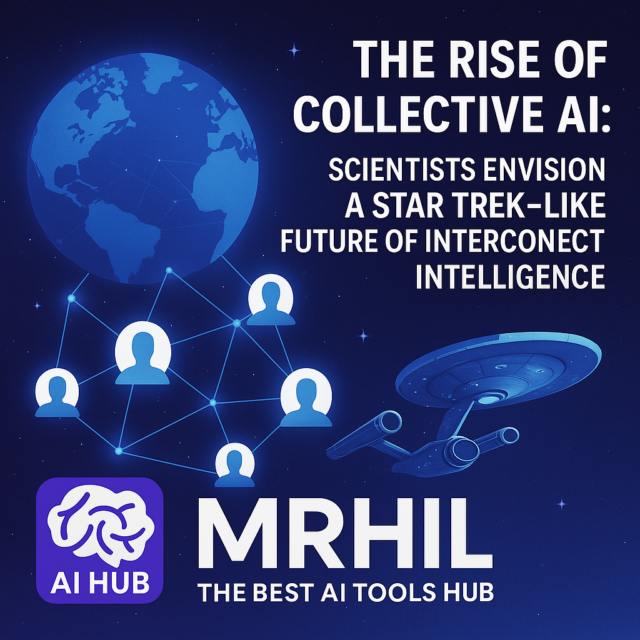
In a fascinating development that bridges science fiction and cutting-edge research, prominent computer scientists from world-renowned institutions including MIT, Yale, and Loughborough University have proposed a revolutionary vision for artificial intelligence that bears a striking resemblance to one of science fiction’s most memorable concepts: the Borg from Star Trek.
Their groundbreaking perspective, published in the prestigious journal Nature Machine Intelligence, outlines a future where independent AI agents operate as a unified network, continuously sharing knowledge and adapting collectively—a phenomenon they’ve termed “Collective AI.” This interconnected approach to artificial intelligence could potentially transform how AI systems evolve, learn, and respond to complex challenges across numerous fields.
From Science Fiction to Scientific Reality
The parallels to Star Trek’s Borg—cybernetic beings functioning as a collective consciousness through a unified network—are unmistakable. However, unlike the dystopian portrayal in science fiction, these leading researchers envision this collective intelligence as a force for unprecedented positive advancement.
Dr. Andrea Soltoggio from Loughborough University, who leads this pioneering research, explains: “Instant knowledge sharing across a collective network of AI units capable of continuously learning and adapting to new data will enable rapid responses to novel situations, challenges, or threats.”
This vision stands in stark contrast to current AI systems, which largely operate as isolated entities with limited ability to share their learned experiences or adapt beyond their initial training.
Practical Applications with Revolutionary Potential
The real-world implications of Collective AI extend far beyond theoretical interest, potentially revolutionizing multiple sectors:
Enhanced Cybersecurity
In cybersecurity environments, the moment one AI unit identifies a new threat, it could instantaneously share this knowledge throughout the network, triggering a coordinated defensive response—mirroring the human immune system’s approach to protecting the body from pathogens.
Disaster Response Innovation
Collective AI could power a new generation of disaster response robots that rapidly adapt to unpredictable conditions. These units would benefit from shared experiences across the network, allowing each individual robot to operate with the collective wisdom of all units that have previously encountered similar situations.
Personalized Medicine Advancement
The medical field could see personalized AI agents that combine cutting-edge medical knowledge with patient-specific information, continuously updating their approaches based on outcomes across the entire network of medical AI units.
“The potential applications are vast and exciting,” notes Dr. Soltoggio, highlighting how this approach could accelerate innovation across virtually every sector.
Addressing Safety Through Decentralization
While acknowledging potential risks—such as the rapid dissemination of potentially harmful knowledge—the researchers emphasize a critical safety feature in their vision: each AI unit maintains its own objectives and independence while participating in the collective.
This approach would create what Dr. Soltoggio describes as “a democracy of AI agents,” significantly reducing the risks associated with centralized AI systems controlled by a small number of entities or organizations.
“This decentralized structure provides an important safeguard against the concentration of power in artificial intelligence systems,” explains Dr. Soltoggio, distinguishing their vision from both dystopian science fiction scenarios and current trends toward increasingly large, centralized AI models.
The Technological Foundation
The researchers arrived at this vision following comprehensive analysis of recent advancements in machine learning, supported by funding from the Defense Advanced Research Project Agency (DARPA). Their investigation revealed two convergent global research trends that provide the foundation for Collective AI:
- Lifelong Learning Capabilities: Enabling AI agents to continuously extend their knowledge throughout their operational lifespan, rather than being limited to knowledge acquired during initial training.
- Universal Knowledge-Sharing Protocols: Developing standardized methods that allow different AI systems to effectively share their learned information and skills with one another.
This approach represents a significant departure from current AI models like ChatGPT, which acquire most of their knowledge during energy-intensive training phases and have limited ability to adapt once deployed.
“Recent research trends are extending AI models with the ability to continuously adapt once deployed, and make their knowledge reusable by other models, effectively recycling knowledge to optimize learning speed and energy demands,” explains Dr. Soltoggio.
A More Sustainable and Efficient AI Future
The researchers assert that current dominant AI models—characterized by their large size, high expense, non-shareable nature, and limited adaptability—will likely be superseded by more sustainable and collaborative approaches.
“We believe that the current dominating large, expensive, non-shareable and non-lifelong AI models will not survive in a future where sustainable, evolving, and sharing collective of AI units are likely to emerge,” Dr. Soltoggio states.
This prediction draws parallels to human knowledge development, which has progressed incrementally over millennia through communication and information sharing. The researchers envision similar dynamics emerging in societies of artificial intelligence units implementing democratic and collaborative collectives.
Expert Endorsement
Professor Nick Jennings, Vice-Chancellor and President of Loughborough University and an internationally recognized authority in AI, autonomous systems, cybersecurity, and agent-based computing, has endorsed this forward-looking research.
“I’m delighted to see Loughborough researchers leading in this important area of AI research,” Professor Jennings commented. “This paper helps set the agenda for the next wave of AI developments, based upon multiple, interacting agents. I look forward to seeing this vision becoming a reality in the coming years.”
Implications for the Future of AI
This research signals a potential paradigm shift in artificial intelligence development—moving away from the current focus on creating increasingly large, isolated models toward building interconnected networks of specialized, adaptable AI units that continuously learn from and contribute to collective knowledge.
Such an approach could address several limitations of current AI systems, including:
- Energy efficiency: Reducing the massive computational resources required for training large models by allowing knowledge to be shared and repurposed
- Adaptability: Enabling AI systems to continuously evolve in response to new information and changing circumstances
- Democratization: Creating more opportunities for diverse participation in AI development rather than concentrating capabilities in a few powerful systems
As this research continues to develop, it may fundamentally reshape our understanding of artificial intelligence—transforming it from a collection of isolated tools into a collaborative ecosystem of interconnected minds working collectively to solve humanity’s most pressing challenges.
The full research paper, titled “A collective AI via lifelong learning and sharing at the edge,” was published in Nature Machine Intelligence on March 22, 2024, and includes contributions from researchers across multiple prestigious institutions.
This vision of Collective AI represents one of the most significant conceptual shifts in artificial intelligence research in recent years, suggesting that the future of AI may be less about building bigger individual models and more about creating smarter, more efficient networks of specialized intelligence—a future where the whole truly becomes greater than the sum of its parts.